|
Lio: Shipshewana Kill-Pen Rescue!
For additional information, please visit the following sites:
- Equine Advocates
- Rescue Network
- Sign an Online Petition
- "What You Can Do"
- Links to Videos of the horrible things that can happen at a slaughterhouse (WARNING: VIDEOS ARE VERY GRAPHIC!)
On January 11, 2002, Sanctuary representatives traveled to Shipshewana, Indiana, with the goal of saving a slaughter-bound horse. Shipshewana, in the heart of Amish country, is home to a major livestock auction. "Shipsy" is known to horse rescuers as one of the worst auctions around, due to the fact that a main element of their business is selling to meat buyers.
Horses sold for meat are found in the "kill-pen". (No euphemisms here!) Unlike their kin at the other end of the barn, (the owned horses, who are paraded individually in front of the crowd, dressed in leather harnesses and bows and hoof-black), slaughter-bound horses are given no coddling or courtesy. Chased out of the livestock trailers that brought them to the auction, the horses are kicked and slapped and screamed at by the Amish youths charged with herding them into the damp, dark holding pens. The frightened animals are shoved into the stalls with no regard for sex, age, size, or condition, and the horses fight to establish a "herd order" in the chaos. Smaller, weaker animals are kicked and bitten, and sick or injured horses huddle in the corners, trying to avoid the commotion. As the auction hour approaches, the pens become crowded, the horses packed in ever tighter by the boys with the whips. Before long, there is no room to kick or fight, and the animals huddle nervously, wild-eyed and whinnying, bracing themselves for whatever evil will befall them next.
At ten o'clock, the auctioneer, the Amish boys, the kill buyers, and other observers gather in a loose circle near the holding pens. Suddenly, a fat gray mare is whisked through the crowd, literally chased through the circle while the auctioneer chants. Her fate is sealed in under ten seconds; sold to the kill-man for $500. A few more horses are raced through before we get our wits about us and realize that these horses are not here to be looked at or contemplated; if they are allowed to pause at all, it is only so the kill buyers can glance at them and estimate their weight, and thus, their value.
Several more horses go through, none in the circle for more than twelve seconds, and we realize that if we don't bid fast, we will save no one. It is loud and chaotic and smoky (the universal rule of not smoking in a barn is ignored here), and the horses plunge frantically into the crowd, trying desperately to escape the slaps and kicks inflicted by the young Amish men. Several horses are chased so viciously and relentlessly that they actually lose their footing and fall to the ground, and are then coaxed back up by more yelling and hitting. Their confusion and pain and anxiety is almost unbearable to see, and yet we watch... if only to bear witness, if only to console ourselves with the fact that we did not turn away.
The kill pen is full of Belgian draft horses, the powerful, living machinery of Amish farms. And since the Amish view their horses as farm implements and nothing more, many of the Belgians in this pen are grievously and horrifyingly injured. They have been worked until they literally cannot stand any longer. Any decent, God-fearing human being would look at these animals and agree that a bullet to the head would be merciful. But a bullet to the head would mean just a dead horse, whereas a trip to the auction (broken leg and all) might put a few hundred dollars in the farmer's pocket. No matter that the animal has slaved for it's master for any number of years, no matter that his swollen, oozing knee is collapsing at every forced step. Just as a broken plow would be sold to the junk man for the metal, these broken animals are sold to the kill-man for meat. There is no mercy at the kill auction.
A Belgian filly, maybe 9 months old, is chased into the circle. The bidding starts and I tentatively raise my hand. "SOLD!" the auctioneer shouts, and when he yells "$300 to number 1050!", I realize that the kill-man got her. A few people in the crowd notice my disappointment, including one of the men who helps run the horses through. "Sorry!", he says, "you gotta yell! We gotta see ya!" A few minutes later, a trio of Belgian colts come through, two yearlings and one who is about 6 months old, all beautiful, healthy babies. The meat man gets the first one, and the second one, and then the auction helper, gesturing toward the remaining colt, catches my eye and yells "you want this one, right?!" I throw my arm up, wave frantically, and yell "Yes! Here! Here!" And then I hear "SOLD!" again, and someone asks for my bidder number. I don't even know what I've bid, but I give my number. Then I turn to watch them chase my colt out of the ring and into another holding pen, silently vowing that if anyone touches my horse with anything but utter gentleness from this second forward, they will face the wrath of a person who has watched horse abuse for a little too long this morning, and who's looking for someone to... discuss it with.
We follow our colt as he is prodded along with the others in his lot. Once they've been herded back into the holding area, we have a chance to get our first real look at him.
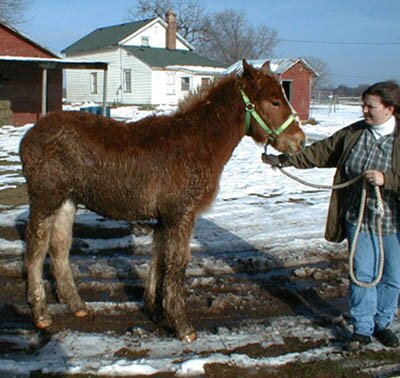
He is filthy and bone-thin, with manure and mud caked deeply into his fur, all along his legs and chest and under his belly. His eyes flash white and terrified as he tries to find a place in yet another pen full of frantic horses. We climb the boards and lean into the pen and try to talk soothingly to him, but bigger horses get in the way and our baby is forced into a corner. Wanting desperately to just get him the hell out of this place, we quickly pay the bill ($169) and somehow get a halter on him, thinking that the nightmare is nearly over. But it isn't. In the parking lot, someone has blocked us in. We head back to the sale barn to pass the time, hoping that whoever it is will leave soon.
Back at the barn, the auctioneer is selling horses from another pen. Two old, blind mares, obviously bonded and dependant on one another, are purchased separately. When one is taken from the pen, the other runs in panicked circles, whinnying frantically, her companion calling back to her as she is led to the livestock truck and loaded on. The pony stallion with an injured penis follows, and then the cute little donkey with the runny eyes. Then come several young, beautiful horses with no apparent injuries or problems. We can only speculate as to how they ended up among these doomed animals... what owners allowed (were tricked?) them to meet this end. Healthy, sick, injured, sound... it's all the same to the meat man. While some kill buyers will re-sell a healthy horse, most of them simply buy and sell horses by the pound. It's much easier to buy a batch of horses at the auction and just send them all to the slaughterhouse, than pick through the lot to determine who is sale-able and who's not. If a few good horses get shipped along with the elderly and infirm, well, ultimately, it's all just meat.
The Belgian with the broken leg likely has a full days' journey ahead, before he arrives at the slaughterhouse in Canada or Tennessee or Illinois. He'll ride in a freezing livestock hauler with other miserable, suffering animals, some of whom will die in transit, their bodies trampled where they fall. There's even a chance that a pregnant horse will make the trip, delivering her foal en route. It happens often enough that the USDA guidelines have a statute to cover slaughter of newborns at the packing plant.
This last, brutal trip will end with a shot to the head from a captive-bolt pistol. The lucky horses will die quickly. The rest will remain conscious through the next few steps of the slaughtering process, including being shackled and hung from their back leg before their throats are cut. As prey animals, horses are extremely sensitive to the threat of danger. We can only imagine the horror they experience, hearing the cries and smelling the blood of their kin at the slaughterhouse. AFTERWARD
We got back to the sanctuary early in the afternoon. Lio stepped out of the horse trailer and immediately fell into a puddle of mud and ice... not quite the glorious arrival we had envisioned for him! We led him to the quarantine area and set him up with clean water and a bale of hay. Knowing that he was stressed and fatigued and completely overwhelmed, we closed the barn doors and let him rest.
The next day, Lio and I spent our first hours alone together. Though he desperately needed a wash to break up the filth and mud that clung to his coat, I decided that the trauma of a full-fledged bath would be worse than the dirt. Instead I spent hours breaking up the mats by hand, til my fingertips were black and numb. It was bonding time, if nothing else.
By Sunday, Lio was depressed and feverish, and the vet diagnosed him with strangles. Thick mucus poured from his nose, and he stood in the barn with his head in a corner. Again, I used this as a bonding opportunity, simply sitting with him and talking to him and picking apart the mats.
Days later, it became clear that his illness was not as serious as strangles after all, and his health and condition have improved tremendously since then. It has been nearly a month since we brought Lio home from the auction. No longer does he flinch every time you touch him, and no longer does he get that panicked look in his eyes when we approach. Daily brushing and grooming have helped rid him of the thick layer of grime that dulled his coat, and now his fur sparkles red, copper, and silver in the sun. Most rewarding is to see Lio act like a normal baby horse... sometimes silly, sometimes spunky, often sweet; occasionally naughty. His gentle brown eyes and long lashes just melt our hearts, and when he actually approaches us, tentatively touching our face and hands with his warm velvet muzzle, the joy of it brings tears to our eyes. To be trusted by an animal whose only prior experience with humans has been painful and frightening, is an insurpassable privilege. Some days, when the sun is warm, we'll find Lio sprawled on the ground in the way that only baby horses can sprawl, sleeping the contented sleep of animals who are fed, loved, and safe. When I call his name to assure myself that he is, indeed, only sleeping, he lifts that big head and blinks his eyes to get his bearings. I like to think that he is saying to himself, "Wow, I'm still here, it's not a dream after all." The Happy Ending
While we loved having him around, we knew that at only 2 or 3 years of age Lio was too young for retirement. Horses enjoy having a job to do, and we knew Lio would be no different. We had a handful of inquiries about him, and in May of 2004 Lio was adopted to a farm where he will have a job being a pulling horse.
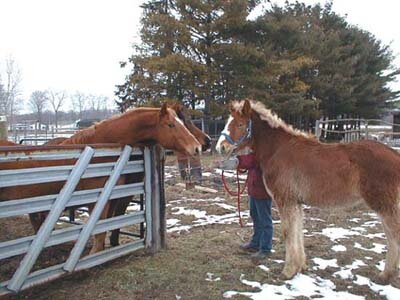 |
| After 30 days of quarantine, Lio was happy to meet the some of the other horses up close. |
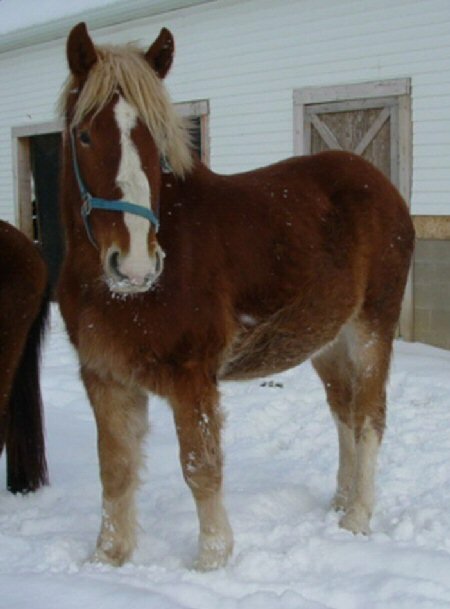 |
| Lio, could you get any bigger?! |
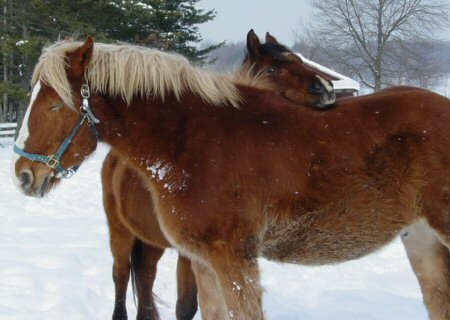 |
| Lio and Tux, happy to be at Grateful Acres |
|