|
Winona: What a $20 Pony Looks Like
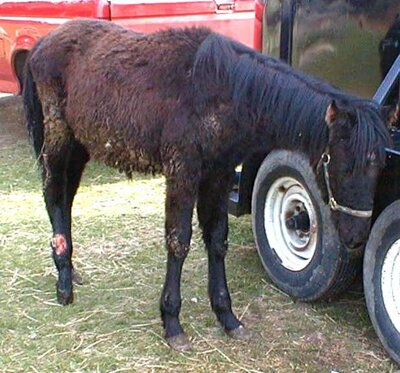
Our first visit to the Shipshewana Livestock Auction (Indiana) was in February of 2001. At that time, we had traveled to "Shipsy" with the specific goal of rescuing a draft horse - the plow horses that are dumped by their Amish owners once the animals are too debilitated to work anymore. That day, we witnessed cruelty and viciousness that we had never imagined. Shipshewana was every bit the evil place about which we had been warned. Ultimately, we were able to save a young Belgian from the "killers", and today, two years later, Lio is a gorgeous, thriving animal. And though we were unable to return to Shipsy for another rescue for almost two years, I thought of the place every single Friday (the day of the kill sales), knowing that there were hundreds of horses, less than an hour away, being brutalized in front of crowds of indifferent, greedy human beings.
Finally, after nearly two years, it was time to visit Shipshewana again. We had saved another slaughterbound horse and placed him in an adoptive home, and that horse needed a friend. His owner, Sue, (a long-time sanctuary friend and supporter) and I traveled to Indiana early on the morning of April 14. Our goal was to find a horse that would be a good companion for "Captain", and one who would also be gentle and friendly for Sue's grandkids. Age, soundness, and appearance were not factors; we knew that God would lead us to the exact horse we were meant to have.
The kill sale was different from last time. This was the Good Friday auction - the biggest of the year. The focus was on saddle horses, brought in by owners hoping to make quick cash. The kill horses were few in number, and we had to search to find the arena where the sale would take place. We finally found a corral with a few rough-looking horses in it, and guessed that these were the "killers". (Auction lingo is strange: the meat buyers are called "kill-men" or "killers", and the term holds no stigma. The horses themselves are also referred to as "killers" or "kills", and their paddock is called the kill-pen. The folks in this business are so matter-of-fact about their industry that they don't even try to disguise it with euphemisms.)
Fewer horses meant that we could look more closely at the individuals. Most noticeable was the hugely pregnant mare, a lovely flea-bit grey horse, fat and apparently sound, and looking like she could foal at any moment. Astounded by the fact that someone would put this horse in the kill-pen (wouldn't a live baby horse be worth more money than whatever the meat price would be?), we then recalled that there was a hugely pregnant mare in the sale a few years back, too. And, although the laws regarding transport of slaughterbound horses had been revised in the past couple of years, specifically forbidding the transport of mares in foal, blind horses, and horses with broken legs, we noticed that of the eight horses in the kill-pen, one was pregnant and two were blind.
The sale began as it had the last time: very suddenly and with no concern for the safety of the horses or the spectators. Horses were whooshed through, chased with whips and screaming, angry voices. Animals slid and fell as they lost their footing on the concrete, but not a moment was spared to assist them or slow the rush of other horses coming through. Somewhere in the chaos we spied a pretty bay pony who looked reasonably healthy and sane… we hadn't noticed her before the sale started. The bidding stopped at $120, and she was ours.
We found her in a paddock a little while later, picking through straw with an older, skeletal white mare. The mare had soft brown eyes and a gentle, resigned expression on her face. As we stood and contemplated our new pony, a young couple approached and asked which horse we had bought. We pointed to the pony, and their faces showed disappointment. They had brought the white mare, and another horse, to the kill sale. The mare had been a trail horse at some resort or lodge when they got her, but in the short time they'd had her things had changed and now the girl was going back to school and couldn't afford tuition and horse feed at the same time; blah, blah, blah. Basically, they had let this horse starve nearly to death, and then put her in the sale hoping to get whatever cash they could out of her. And now, learning that we were "rescuers", they tried to persuade Sue and me to find the meat man with the winning bid, and buy the mare from him. Disgusted though we were by their ploy (they wanted to tell themselves that a rescue person got their horse, not a kill-man) we did seek out and find the killer who had bought this horse. We were relieved to learn that the mare had already been re-sold to someone who recognized her potential, and who planned to rehabilitate her and use her as a kids' horse. (Or so we were told.)
We turned our attention back to the bay pony. She was a frisky little thing, but easily approached and completely pet-able. We brought her water, and then left to wander around the auction grounds. There were several other horses, donkeys, and ponies that caught our eye, but we had come to the sale just to get one pony, a pal for Captain, and that had been accomplished. Now, we meandered around, just looking, offering pats and comforting words to the animals who were in obvious distress. We wondered aloud what kind of dead-hearted human beings would bring animals to this place. At the sale a couple years back, we had met no other rescue people, but this time we met several women who were there specifically to see what could be saved. To our great relief, there was a donkey rescue person, who planned to bid on two sickly, scruffy miniature donkeys (the fact that they could have fit easily into our horse trailer with the new pony was beginning to weigh on my mind)... Another young lady was there taking close-up pictures of the blown-out knees on draft horses and mules... Two other women discussed the salvageability of a gentle-seeming horse who gushed snot and tears from his eyes and nose. And then, a man standing next to us, who must have been listening to our conversation, politely interrupted, and told us there was a horse we needed to see.
We followed the man with a toddler on his shoulders, right into the main center aisle of the auction barn. We could see as we got closer that there were a few people congregated around and pointing at a small horse who was tied up in the aisle. They wore looks of disgust on their faces, and I began to feel apprehensive... what were they seeing that warranted those looks, in a place like this, where sick and injured horses were everywhere you turned? With growing dread, we turned the corner and jostled our way up to the pony to have a closer look.
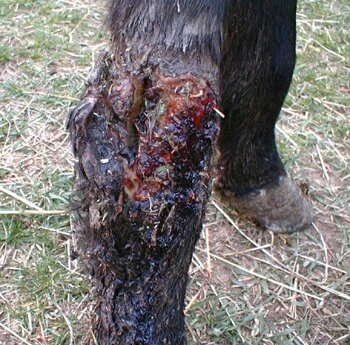
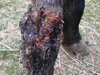
She was a frail, black, wisp of a horse, her head hanging low in the corner where she was tied. Her posture was one of pain, fever, starvation, and total debilitation. She was absolutely filthy dirty, with giant clumps of cow manure hanging from her patchy, shaggy winter coat. When I touched her back, ever bump on her spine, and every rib, protruded. She was a mess, but then, they all were... so what was the big deal here? Then we saw her leg, and gasped. The lower left leg was a hugely swollen, blackened, stinking, festering cesspool of a wound. I suddenly understood the shocked and disgusted faces. The cut, (it had to have been made by barbed wire) was in two distinct sections, and in between was visible bone. The injury had to have been a week old, but was so massive and deep that it still bled and oozed down her leg, leaving a trail of crusted filth all the way down to her hoof. Her eyes were but half open, her breathing slow, her responses dull. Her entire being was resigned, hopeless. She was just waiting for it to be over.
The man who led us to this pony told us what he knew. There had been another kill sale, right there in the auction barn, that we did not even know about. The pony had "no-saled" (when even the meat man won't buy the animal, knowing that the animal is too frail to survive transport). At the last moment, however, one of the killers did buy her, for $20. Then she was truly doomed. The little horse would know no mercy. She would be made to walk on that leg, would be chased and screamed at if she faltered, would be crammed in the hauler with bigger horses who would bite and kick and crush her in their own fear and pain. She would be dead before she reached the slaughterhouse.
We looked closer at the leg, wondering if it could possibly be healed. We had had another rescue once, with an injury much less severe, who had been healed with simple honey dressings. Could it work on something this drastic? Even the other rescuers, who had followed us over to take a look at this pathetic little animal, shook their heads in doubt. It was then I knew I had to have her.
We tracked down the buyer through the auction office, and offered him $40 for the half-dead pony. He insisted he'd take no less than $75, since he "could easily turn around and get $125" for her from the next kill buyer. This was just wishful, greedy thinking on his part, but we wrote the man a check. Because the dealer was not planning to cash out until the end of the day, we had to wait several hours before the buyer's paperwork was completed. We brought water to the pony and spent several minutes petting her, comforting her, and reassuring her that this miserable day would soon be over.
Again, we had time to fill. Many more kill horses had been brought to the sale by now, and we learned that there were at least three or four kill-pen auctions that day. We recognized the kill-pen auctioneer, and watched to see where he went. Later in the day, we followed him to a dim, out-of-the-way corner of the barn. Here were several aged plow mules and Belgians, and a few other horses who had no visible age or infirmities. The auctioneer and the dealers laughed and heckled each other for a while, and then got down to business. A Belgian mare went through and was herded into the holding pen after the meat man got her. A few more followed, and the pen grew more crowded. Then a huge Belgian stallion, regal and awesome even in this bleak place, went through the sale and was herded in with the others. The gate swung shut and suddenly the stallion reared, all two thousand pounds of him, and mounted one of the mares. Other horses scrambled and fought to get out of the way, whinnying frantically in the crowded chaos. The breeding was sustained and violent, and the killers took the opportunity to watch and make jokes about the scene:
"Hey Buddy! Got yer papers for that horse?! Somebody owes somebody a stud fee!"
"Hey, look it now, he's makin' the most of this ain't he?!"
"Heh, heh, somebody's gettin' a free colt outta the deal!"
And so on. The fact that these were all doomed animals did not create any sense of solemnity or regretful respect in the men. In fact, their doomed state seemed to incite, if anything, more hostility and cruelty in the men. Studies have shown that slaughterhouse workers (not just horse slaughterhouses, but all such places) will frequently become even more violent and abusive to the animals they process than is inherently necessary. While I do not remember if the reason for this dynamic was ever fully explained, I do believe that the behavior is prevalent at Shipsy.
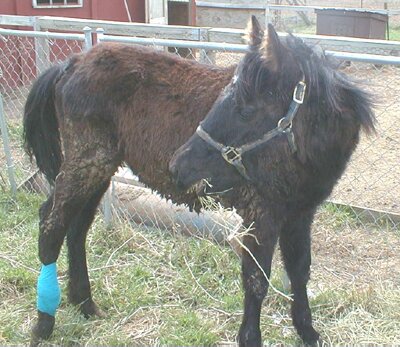
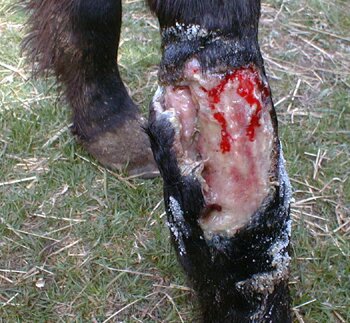
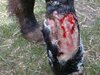
We finally cashed out at around 4:00 PM, and loaded our ponies onto the trailer. The bay pony was taken to Sue's, but the next day it was clear that the pony had been drugged for the sale. Her fearfulness and temperament led us to place her with a more knowledgeable and experienced owner, and she is now being rehabilitated by a kind and competent trainer. The little black horse, Winona (like windy), was brought back to Grateful Acres to begin her long recovery. Sanctuary friends gathered around and fawned over the pony as soon as she came off the trailer, offering kindness and gentleness that she had probably not known for ages. The injured leg was soaked and cleaned, and then doused with pure honey and wrapped. Winona was given antibiotics and then placed in a small private stall, with abundant hay and fresh water.
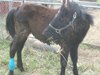
It was several days before we felt she had all four feet on this side of death's door, but within a week we were confident that her wound was responding to treatment and the infection was leaving her body. Winona was put on a small pasture with fresh spring grass, and was wormed and de-loused. Another auction rescue, Lio, was placed in the same pasture to be Winona's companion, and this lifted her spirits even more. Now, a full two months after her rescue, Winona's flaky skin and patchy, mangy fur are being shed and replaced with a sleek, shiny black coat. Daily attention to her wound has paid off, and what started out as a dollar-bill sized injury has shrunk down to an area the size of my thumb. Her gaunt, bony frame has begun filling out, and her frail helplessness is being replaced by the spunky sweetness of a normal two-year-old filly.
Our dining room windows look out on Winona's pasture, and just lately we've seen her join in with the other animals in spontaneous bursts of energy and playfulness. And so today we call her rescue a complete success. She is pain-free, trusting of people, and is able to play and be silly. We could ask nothing more for this baby, but her future looks even brighter now. I was recently contacted by a young man who has been driving by the sanctuary and watching Winona's progress. We have since met, and made arrangements for him to adopt the pony. Very soon, Winona will be moving to an 80-acre farm, where she will be companion to another young pony, each of them there for no other purpose than to be loved and cuddled by kind admirers!
Click the thumbnails below to see pictures of Winona and her leg injury.
 |
 |
 |
| Looking better already! |
Winona's leg injury prior to treatment |
Winona's leg injury after cleaning and beginning of treatment |
|